
Yes — if you or anyone in your household gets Section 8, lives in public housing, or receives other federal housing assistance, you already meet the eligibility test for a free government phone. Federal housing help is one of the five federal programs that qualify you for Lifeline, and you don’t have to prove your income separately. Your housing assistance is enough on its own.
This guide explains exactly which housing programs count, why Section 8 applicants often get approved faster than anyone else, how to apply step by step, and what you honestly get.
Does Section 8 qualify you for a free phone?
Here’s the short version:
- Lifeline gives you a discount of $9.25 a month off phone or internet service. If you live on qualifying Tribal lands, it’s up to $34.25 a month.
- Many companies apply that discount to a basic plan and charge you $0 — that’s what people mean by a “free government phone.”
- Federal Public Housing Assistance (FPHA) is a qualifying program, right alongside SNAP, Medicaid, SSI and Veterans Pension.
- Only one benefit per household, not one per person.
- There is never an application fee. Not to USAC, not to a provider.
Lifeline is run by the Universal Service Administrative Company (USAC) and overseen by the FCC. If you want the full picture of how the discount works, see our guide to the Lifeline discount amount.
What counts as “Federal Public Housing Assistance”?
FPHA means rental help funded by the U.S. Department of Housing and Urban Development (HUD). Not every kind of rent help is HUD rent help, so here’s the plain breakdown.
| The housing help you get | Does it qualify you for Lifeline? |
|---|---|
| Section 8 Housing Choice Voucher (HCV) | Yes |
| Project-based Section 8 (subsidy attached to your unit) | Yes |
| Public housing run by a Public Housing Agency (PHA) | Yes |
| HUD-VASH voucher for veterans | Yes — it’s a Housing Choice Voucher |
| HUD-subsidized senior or disability housing (Section 202 / 811) | Usually yes, if the unit gets HUD rental assistance — ask your property manager |
| Tribal housing assistance on Tribal lands | Yes — and you may get the larger benefit |
| Tax-credit (LIHTC) apartment with reduced rent but no HUD subsidy | Not by itself |
| USDA rural rental assistance | Not HUD — it won’t show up in the HUD records, so use the income route |
| State or city rent programs, or one-time emergency rent help | Not by itself |
| Sitting on a Section 8 waiting list | No — you have to actually be receiving the help |
Not sure which bucket you’re in? Call your local Public Housing Agency and ask one question: “Is my rent assistance funded by HUD?” You can look up your agency on HUD’s list of PHA contacts.
And if the answer is no, you’re not out of options. You can still qualify through Medicaid, SNAP/EBT, SSI, a Veterans Pension, or your income. Our Lifeline eligibility guide walks through every path. For 2026, the income limit is 135% of the Federal Poverty Guidelines — $21,546 a year for one person and $44,550 for a household of four, with higher limits in Alaska and Hawaii.
Living on Tribal lands changes the math in your favor. See our Tribal Lifeline guide for the enhanced benefit.
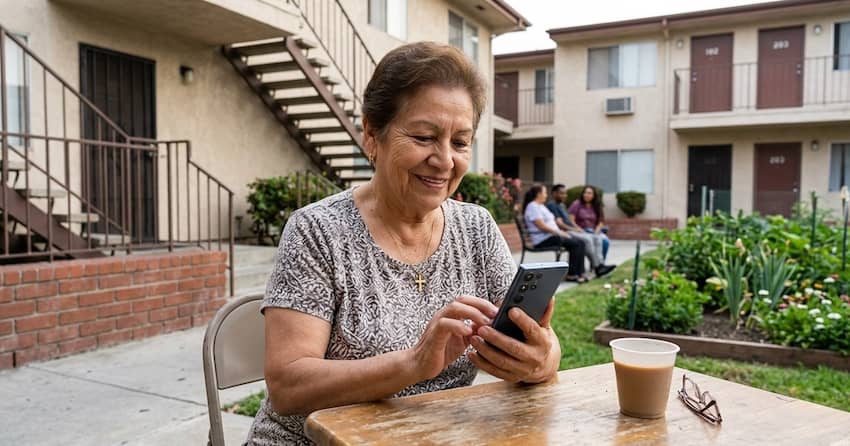
Why Section 8 applicants often get approved the fastest
This is the part almost nobody tells you, and it’s genuinely good news.
When you apply, your information goes to a system called the National Verifier, which tries to confirm your eligibility automatically before it ever asks you for paperwork. USAC has a direct federal data connection with HUD to check Federal Public Housing Assistance, and that connection covers every state and territory.
Compare that to the other programs. SNAP is only checked automatically in around 22 states, and SSI in just Michigan and Wisconsin — everyone else has to upload documents and wait for a person to review them.
So if you qualify through housing, there’s a good chance the system finds you in seconds and you never upload anything at all.
The match only works if your details line up with HUD’s records. Apply using the exact name on your voucher or lease — not a nickname, not a maiden name you no longer use — and include your apartment number.
What you actually get (and what you don’t)
Let’s set honest expectations, because a lot of sites oversell this.
What’s real:
- A $9.25 monthly discount you can put toward a cell phone plan, home internet, or a bundle — one service, your choice.
- Most Lifeline carriers build a no-cost plan around that discount, usually including talk, text, and a set amount of data.
What’s often misunderstood:
- The FCC does not pay for the handset itself. The FCC doesn’t subsidize any hardware connected to Lifeline, including phones a company gives to a customer. A free phone is something individual carriers choose to offer to win your business — it isn’t part of the federal benefit.
- Some providers hand you a free device. Others give you a SIM card and expect you to bring your own phone. If you already own a working phone, our BYOP guide explains how that works.
- Plans, data amounts, and phone models change constantly. Compare before you commit using our best Lifeline providers roundup and best Lifeline phones list. If you’re an older adult in Section 202 housing, our guide to the best providers for seniors narrows it down further.
How to apply with Section 8 or public housing
- Find companies that serve your address. Use the official “Companies Near Me” tool at lifelinesupport.org/companies-near-me. Carriers come and go, so check your own ZIP code rather than trusting a list you read somewhere. Our guide on how to verify a Lifeline provider shows you what to look for.
- Gather your details. Your full legal name as it appears on your lease or voucher, date of birth, the last four digits of your Social Security number, and your complete physical address including unit or apartment number.
- Start your application. Apply yourself online at lifelinesupport.org, let a provider submit it for you, or mail a paper application.
- Choose Federal Public Housing Assistance as your qualifying program when the form asks how you qualify.
- Let the automatic check run. This is where housing applicants usually sail through.
- Send proof only if you’re asked. Documents uploaded online during business hours, 9 a.m. to 9 p.m. ET, are usually reviewed within minutes, while mailed documents take about seven to ten business days to get a decision.
- Pick your company and activate. Once you’re approved, sign up with the provider you chose and set up your phone. Our activation guide covers the setup steps.
Prefer doing this in person? Many providers run sign-up tables at community centers and outside stores. Here’s how to find one near you.
If you’re asked for proof, here’s what works
Your document needs to show four things: your name (or your dependent’s), the program name, the agency that issued it, and a date within the last 12 months or a future expiration date.
Good examples for housing:
- Your current lease showing HUD rental assistance
- Your Housing Choice Voucher paperwork
- Your annual recertification letter from your PHA
- A benefit approval or award letter from the housing agency
Take a clear, bright photo or scan. Never mail original documents — send copies only. If you’re mailing, the address is Lifeline Support Center, PO Box 1000, Horseheads, NY 14845.
The one-per-household rule in an apartment building
This trips up more public housing residents than anything else, because Lifeline’s definition of “household” is not the same as HUD’s.
For Lifeline, a household means everyone living at the same address who shares income and household expenses. Only one benefit is allowed per household.
What that means in practice:
- You and your spouse or partner sharing bills? That’s one household. One benefit between you.
- Roommates who split nothing — separate food, separate money? You can each get your own benefit, but you’ll need to complete a Lifeline Household Worksheet to show you’re separate households.
- Neighbors in different units of the same building? Different addresses entirely. Just make sure your apartment number is on the application, or the system may flag you as a duplicate at an address that already has a subscriber.
Our one-per-household rule guide breaks down the worksheet in more detail.
Common denials — and how to fix each one
| What went wrong | How to fix it |
|---|---|
| Your name doesn’t match HUD records | Reapply using the exact name on your voucher or lease |
| Address was rejected | Add the apartment or unit number and re-enter it |
| Only the head of household is on the HUD paperwork | Apply in that person’s name, or qualify through a different program or income |
| Someone at your address already has Lifeline | Complete the Household Worksheet |
| Your document is over 12 months old | Ask your PHA for a current letter |
If you’ve already been turned down, our guide on what to do when your Lifeline application is denied walks through the appeal.
Protect yourself from scams
Lifeline costs nothing. If anyone asks you to pay a fee to apply, to “reserve” a phone, or to speed up approval, walk away — that’s not how the program works. There’s no deposit and no activation fee with a legitimate provider.
Be careful about handing your Social Security number to someone at a folding table until you’ve confirmed the company is a real Lifeline carrier. Our Lifeline scam alert covers the warning signs.
If you live in California, Texas, or Oregon
Three states handle verification differently. Oregon and Texas don’t use the National Verifier the same way other states do — they run their own systems. California has its own state LifeLine program layered on top of the federal benefit, with its own rules and administrator. If you’re in CA, start with our California Lifeline guide and our explainer on Solix and the California application process. USAC
Frequently asked questions
No — it qualifies you, but you still have to apply and choose a provider. The good news is that Federal Public Housing Assistance is checked against HUD records automatically in every state, so approval is often immediate.
Only if you’re genuinely separate households — you don’t share income or expenses. In that case you each apply and complete a Lifeline Household Worksheet. If you share bills, the household gets one benefit total.
Yes. The rule covers you, your dependents, or anyone in your household receiving the benefit. If someone in your household gets federal housing assistance, your household qualifies.
Yes. The discount can go toward phone service, internet service, or a bundle — but only one service at a time, and only one benefit per household.
Not through housing, unfortunately — you have to be receiving the assistance, not waiting for it. But check the other routes: SNAP, Medicaid, SSI, Veterans Pension, or your household income.
You have to recertify once a year, but you may not have to do anything. USAC runs an automatic data check first, and subscribers who pass don’t need to take any further action. If the check fails, you get a 60-day window to recertify, and missing it means automatic de-enrollment. Because HUD data is connected nationwide, housing-qualified subscribers often pass automatically. See our recertification guide.