
Access Wireless is a real, long-running Lifeline provider that gives eligible low-income households a free phone plan for $0 a month; unlimited talk and text, monthly high-speed data, and mobile hotspot. It’s run by i-wireless, LLC (part of the Kroger family of companies) and it’s an FCC-approved carrier, so the benefit is legitimate.
The free phones are basic, coverage and data amounts change from state to state, and customer service gets mixed reviews. This guide walks through the plans, phones, network, real customer experiences, and how Access stacks up against other providers; so you can decide if it’s the right fit before you apply.
Access Wireless delivers the federal Lifeline benefit, the government program that lowers phone and internet costs for people with low income.
Access Wireless at a glance (2026)
| Feature | What you get |
|---|---|
| Monthly cost | $0 for the Lifeline plan (if you qualify) |
| What’s included | Unlimited talk, unlimited text, high-speed data + hotspot (amount varies by state) |
| Network | Nationwide GSM 4G/5G LTE (T-Mobile-based) |
| Free phone? | Yes, where available — usually an entry-level Android |
| Bring your own phone? | Yes — a BYOP SIM is available |
| Availability | ~39 states + Washington, D.C. |
| Run by | i-wireless, LLC d/b/a Access Wireless (Kroger family) |
| Best for | People who want a simple, no-cost plan and don’t need a high-end phone |
Always double-check before you enroll. Provider offers, phone models, data amounts, and coverage change often. Confirm Access serves your ZIP code on USAC’s Companies Near Me tool and review the current plan for your state.
What is Access Wireless?
Access Wireless is a Lifeline-only wireless service. That means its plans are paid for through the federal Lifeline program instead of a normal monthly bill. The company behind it is i-wireless, LLC, which does business as Access Wireless and is also connected to Kroger Wireless. It’s an Eligible Telecommunications Carrier (ETC), which is the FCC’s term for a provider that’s approved to offer the Lifeline discount.
Lifeline is run day to day by USAC (the Universal Service Administrative Company) under FCC rules. The discount is up to $9.25 a month, or up to $34.25 a month for households on qualifying Tribal lands. Providers like Access use that money to give you free service — and often a free phone. You can read more about how much the Lifeline discount is worth.
Access has been in the Lifeline space for years, which is a point in its favor. Some carriers come and go; Access has stuck around and keeps its website, shop, and enrollment tools active and up to date.
Who is Access Wireless best for?
Access is a solid pick if you:
- Want a truly free phone plan and don’t want to pay a monthly bill.
- Are fine with a basic smartphone (or want to bring your own).
- Live in one of the states Access covers and get decent T-Mobile signal in your area.
- Value simple talk, text, and everyday data over the largest possible data bucket.
It’s a weaker pick if you need a lot of high-speed data every month, want a premium phone for free, or you rely on fast phone support to fix problems.
Access Wireless plans — what you actually get
Every Access Wireless Lifeline plan includes unlimited talk, unlimited text, and free high-speed data, plus the ability to use your phone as a Wi-Fi hotspot. The exact amount of high-speed data depends on your state, because Lifeline rules and provider offers differ from place to place. Before you sign up, check the plan details for your state so you know how much data you’ll get.
A few things to keep in mind:
- It’s one benefit per household. Lifeline allows only one discount per household — not one per person. If someone at your address already has Lifeline, you can’t stack a second one. Here’s how the one-per-household rule works.
- You recertify every year. To keep your free service, you’ll need to recertify your Lifeline eligibility annually. Access will notify you when it’s time.
- Need more data or minutes? Access sells prepaid top-up “pins” at stores like 7-Eleven, Family Dollar, and Speedway, or through Kroger-family stores, and you can add airtime online with a card.
If your data suddenly stops working after activation, it’s usually an APN (network settings) issue — our Access Wireless APN settings guide walks through the fix.
Free phone and devices — Set your expectations honestly
Access Wireless offers a free smartphone to eligible new customers where devices are available. In practice, that’s typically an entry-level Android — enough for calls, texts, apps, and basic browsing, but not a flagship. Which model you get depends on your state and what’s in stock, so no provider can promise a specific phone. See what to realistically expect on our Access Wireless free government phone page.
You have three device paths with Access:
- Take the free phone that comes with your plan (a basic Android, where available).
- Bring your own phone (BYOP). Access sells a low-cost BYOP SIM, so if you already own a compatible, unlocked GSM phone, you can keep it. Here’s how bringing your own phone to Lifeline works.
- Buy an upgrade. Access’s online shop sells newer phones — from budget models under $70 up to recent Samsung and iPhone models costing several hundred dollars — that you pay for yourself.
The bottom line on phones: the free device is basic, and a number of customers say the free phones are low quality. If you want something nicer, plan to bring your own or buy an upgrade. Don’t expect a free iPhone or free flagship Samsung — that’s a common myth in this space.
Coverage and network
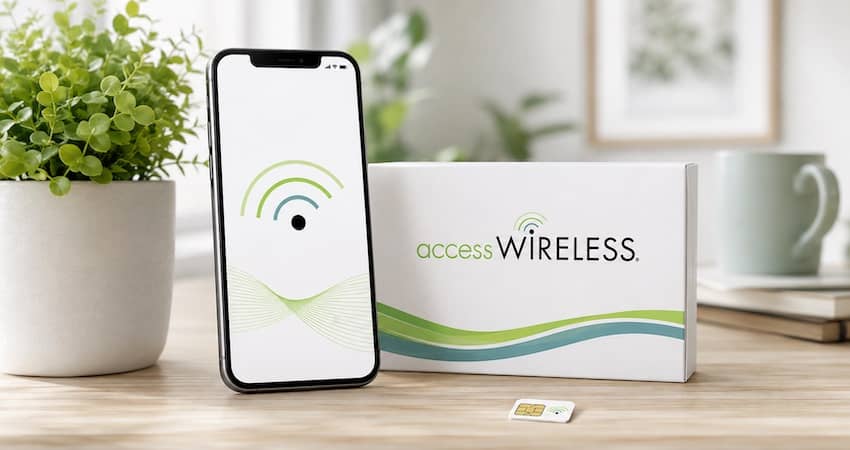
Access Wireless runs on a nationwide GSM 4G/5G LTE network. Its parent company, i-wireless, was historically tied to the Sprint network; after the Sprint–T-Mobile merger, that service moved to T-Mobile’s nationwide GSM network, which is why Access now uses GSM SIMs and phones.
That gives Access strong coverage in most cities and suburbs. Like any T-Mobile-based carrier, signal can be weaker in some rural and remote areas, so it’s smart to check coverage at your exact address before enrolling.
Access Wireless is available in roughly 39 states plus Washington, D.C.: Alabama, Arkansas, Arizona, California, Colorado, Connecticut, Delaware, Florida, Georgia, Iowa, Idaho, Illinois, Indiana, Kansas, Kentucky, Louisiana, Maryland, Michigan, Minnesota, Missouri, Mississippi, North Carolina, Nebraska, New Hampshire, Nevada, New York, Ohio, Oklahoma, Oregon, Pennsylvania, Rhode Island, South Carolina, Tennessee, Texas, Utah, Virginia, Washington, Wisconsin, and West Virginia, along with D.C.
Availability and offers can change, so enter your ZIP code on the Access Wireless Lifeline page or on Companies Near Me to confirm.
Customer service and reputation
This is where Access Wireless gets mixed reviews, and it’s the most important section to read before you commit.
What happy customers say. On review sites, some long-term users are genuinely satisfied. Common themes among positive reviews: reliable signal in their area, no dropped calls, data that refreshes on time, and simple appreciation that the service is free and does the job.
What frustrated customers say. The complaints are consistent across the Better Business Bureau, Trustpilot, and consumer-complaint sites, and they cluster around a few issues:
- Hard-to-reach customer service — long hold times and difficulty getting a live person, especially outside business hours.
- Shipping and activation delays — some new customers wait longer than expected for a phone or SIM.
How to protect yourself: Access Wireless never charges an application fee — Lifeline is free. Apply directly through the official Access website or the National Verifier, be cautious with anyone selling “upgrades” at a folding table, and make sure you actually want the service before you hand over your ID. If something feels off, our Lifeline scam alert guide and how to verify a Lifeline provider explain the warning signs.
None of this means Access is a scam; it’s a legitimate, FCC-approved carrier. It means your experience can depend a lot on your device, your area, and whether you enroll through official channels.
Access Wireless pros and cons
Pros
- Genuinely free plan — $0/month with unlimited talk, text, and data
- Free smartphone available to eligible new customers (where in stock)
- Bring-your-own-phone option with a low-cost SIM
- Runs on T-Mobile’s nationwide GSM 4G/5G LTE network
- Hotspot included, plus easy prepaid top-ups at major stores
- Long-established provider that stays active and current
Cons
- Free phones are basic and draw quality complaints
- Customer service can be slow and hard to reach
- Data amount and offers vary by state — not always generous
- Some reports of pushy in-person reps and shipping delays
- Weaker coverage in some rural/remote areas (as with any T-Mobile-based carrier)
How Access Wireless compares to other Lifeline providers
Access is a middle-of-the-pack pick — reliable and free, but not the flashiest. Here’s how it lines up against three popular carriers so you can weigh your options:
| Provider | Network | Free phone | Stands out for |
|---|---|---|---|
| Access Wireless | T-Mobile (GSM) | Basic Android, where available | Simple, no-cost plan; BYOP option |
| Assurance Wireless | T-Mobile | Entry-level Android in most states | Generous hotspot data on a strong network |
| SafeLink Wireless | Verizon/TracFone family | Varies by state | Wide reach and a big provider behind it |
| AirTalk Wireless | T-Mobile | Larger device selection, incl. refurbished models | More phone choice and upgrade options |
If you want to compare the whole field, our roundup of the best Lifeline providers breaks down who serves which states and what each one includes. And if you already have Lifeline elsewhere, you can switch providers and keep your number — just remember the 60-day usage rule that applies to transfers, explained in our guide to switching Lifeline providers.
How to apply for Access Wireless
Getting started is straightforward:
- Check that you qualify. You’re eligible if your household income is at or below 135% of the Federal Poverty Guidelines, or if you’re on a qualifying program like SNAP, Medicaid, SSI, Federal Public Housing Assistance, Veterans or Survivors Pension, or a Tribal program. See the full list on our Lifeline eligibility guide.
- Confirm your eligibility with the National Verifier. For most states, you must be approved through the National Verifier before you enroll with Access. (California, Texas, and Oregon use their own state processes — for example, see our California Lifeline guide and Texas Lifeline guide.)
- Enroll on the Access Wireless site. Enter your ZIP code, complete the application, and pick your free phone or the BYOP option.
- Activate your phone when it arrives. Our Access Wireless activation guide and general government phone activation hub walk you through each step.
Want the full walkthrough from start to finish? Follow our step-by-step guide on how to apply for Lifeline.
Frequently asked questions
Yes. Access Wireless is the brand name for i-wireless, LLC, an FCC-approved Eligible Telecommunications Carrier in the federal Lifeline program. The free service is real and government-funded. Just be sure to enroll through official channels rather than an unknown third party.
Yes — the Lifeline plan is $0 a month if you qualify. Lifeline covers up to $9.25 a month (up to $34.25 on Tribal lands). No legitimate provider, including Access, charges an application fee. If anyone asks you to pay to apply, that’s a red flag.
Access runs on a nationwide GSM 4G/5G LTE network. Its service is now carried on T-Mobile’s network, following the Sprint–T-Mobile merger, which is why Access uses GSM SIMs and phones.
Access serves about 39 states plus Washington, D.C. Offers and coverage vary by state, so enter your ZIP code on the Access Wireless site or on USAC’s Companies Near Me tool to confirm service at your address.
Where devices are available, yes — usually an entry-level Android for eligible new customers. Exact models vary by state and stock. You can also bring your own compatible phone with a low-cost SIM, or buy an upgraded phone from the Access shop.
Yes. You can port (transfer) your existing number to Access when you enroll. Remember that Lifeline is one benefit per household, and if you’re moving from another Lifeline provider, a 60-day usage rule may apply.
The verdict
Access Wireless is a legitimate, no-cost Lifeline option that does the basics well: free unlimited talk and text, monthly data, hotspot, and a free (if basic) phone on T-Mobile’s network. It’s a good choice if you want simple, free service and either don’t mind an entry-level phone or plan to bring your own.
Just go in with clear eyes: the free phones are modest, data varies by state, and customer service can test your patience. Enroll directly, check your state’s plan and coverage first, and you’ll know exactly what you’re getting.