
Assist Wireless is a real, FCC-approved Lifeline provider. If you live in Oklahoma, Arkansas, Missouri, or Maryland and meet the income or program rules, it can give you free monthly talk, text, and data. Its biggest strength is people: with more than 30 stores across Oklahoma, you can walk in and get signed up face-to-face.
The catch? The “free phone” you see in the ads is mainly tied to Tribal Lifeline, and phone support can be hard to reach. Below is an honest look at the plans, the states covered, the real pros and cons, and how to apply.
Is Assist Wireless legit?
Yes. Assist Wireless, LLC is a federal Lifeline-supported service and calls itself the #1 Lifeline provider in Oklahoma. Lifeline is the government program that lowers the cost of phone or internet service for people with low income, and it has been around since 1985.
Here’s how Lifeline works in simple terms:
- The benefit is a monthly discount of $9.25 for most people, or up to $34.25 if you live on qualifying Tribal lands. You can read more in our guide to the Lifeline discount amount.
- It’s one benefit per household, not per person. See the one-per-household rule.
- The program is run by USAC (the Universal Service Administrative Company) and overseen by the FCC.
- You must recertify once a year to keep it. Here’s how recertification works.
Assist applies that discount to a $0/month plan, so most customers pay nothing for service. Before you sign up, it’s smart to confirm Assist serves your ZIP code using the official Companies Near Me tool from USAC. Provider coverage changes over time, so a quick check protects you.
Which states does Assist Wireless cover?
As of 2026, Assist Wireless offers free Lifeline phone service in four states:
| State | Coverage |
|---|---|
| Oklahoma | Home state — 30+ retail stores; Tribal and non-Tribal plans |
| Arkansas | Statewide Lifeline plan |
| Missouri | Statewide Lifeline plan |
| Maryland | Statewide Lifeline plan |
If you live outside these four states, Assist can’t help you yet, but plenty of other carriers can. Start with our roundup of the best Lifeline providers.
Even inside these states, coverage isn’t everywhere. Always check your exact address on the USAC tool and on Assist’s own coverage map before you enroll.
Assist Wireless plans and data in 2026
Assist keeps its plans simple. If you qualify, the main plan is free every month. Here’s what that includes:
| Plan | Who it’s for | What you get | Price |
|---|---|---|---|
| Standard Lifeline | Arkansas, Maryland, Missouri, and non-Tribal Oklahoma | About 300 minutes, 300 texts, and roughly 4.5 GB of data per month | Free if eligible |
| Tribal Lifeline | Oklahoma residents on federally recognized Tribal lands | Unlimited talk and text, plus about 4.5 GB of data per month | Free if eligible |
| Paid upgrades | Anyone who wants more | Extra data and higher plans | Starting at $1/month |
You can also add data as a one-time top-up when you run low. Plan details and data amounts do change from time to time and can vary by state, so confirm the current numbers when you enroll.
The Tribal Lifeline plan is the standout here. Unlimited talk and text is a real step up from the standard plan, and it comes with the enhanced Tribal benefit. If you live on Tribal lands, read our full Tribal Lifeline guide to see how much more you can get.
The free phone — what you actually get
This is where honesty matters, because the ads can be misleading.
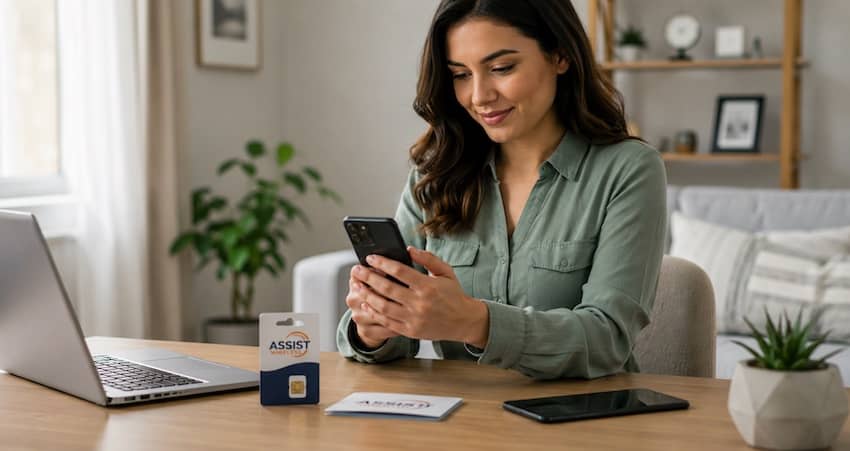
Assist Wireless’s free phone offer is mainly for new Tribal Lifeline customers. If you qualify for Tribal Lifeline and enroll as a new customer, Assist usually includes at least one free basic smartphone. Existing customers and non-Tribal customers are treated differently.
If you’re on the standard (non-Tribal) plan, your service is still free, but the phone is not automatically free. You have two choices:
- Buy a low-cost phone in one of Assist’s stores. These are budget Android models, often just a few dollars.
- Bring your own phone (called BYOP). If you already own an unlocked, compatible phone, you can use it and skip buying a new one. Our bring-your-own-phone guide explains how to check if your phone will work.
One thing to keep in mind: don’t expect a free flagship phone or a free iPhone here. Assist offers reliable, entry-level Android phones. If a high-end device is your goal, compare your options in our list of the best Lifeline phones.
Coverage and network
Assist runs on a nationwide 4G LTE network, and newer phones can reach 5G in some areas. Coverage is strongest in and around its home markets, especially across Oklahoma.
As with any wireless service, signal can drop in rural pockets, indoors, or in bad weather. Off-network roaming is not included on Lifeline plans, so if you travel far from covered areas, your data may not follow you. Check Assist’s official coverage map for your specific address before you commit.
Who is Assist Wireless best for?
Assist is a strong pick if you:
- Live in Oklahoma, especially near one of its 30-plus stores.
- Want in-person help signing up instead of doing everything online.
- Live on Oklahoma Tribal lands – the unlimited plan plus a free phone is genuinely good value.
- Get SNAP (food stamps), Medicaid, or SSI and live in one of the four covered states.
It’s a weaker choice if you:
- Live far from a store and expect fast phone or online support.
- Want a free high-end phone.
- Live outside Oklahoma, Arkansas, Missouri, or Maryland.
Do you qualify for Assist Wireless?
You can qualify in one of two ways.
1. By income. Your household income must be at or below 135% of the Federal Poverty Guidelines. This limit changes each year and goes up with household size.
2. By program. You automatically qualify if you or someone in your home takes part in one of these:
- SNAP (food stamps / EBT) – see free government phone with EBT
- Medicaid
- Supplemental Security Income (SSI) – see Lifeline for SSI recipients
- Federal Public Housing Assistance (Section 8)
- Veterans Pension or Survivors Benefit
- Certain Tribal programs (for the Tribal benefit)
Remember, it’s one benefit per household, you’ll verify through the National Verifier, and you may need to send documents. For the full picture, read our Lifeline eligibility guide.
Assist Wireless pros and cons
Here’s the honest balance sheet, based on the company’s plans and real customer feedback.
Pros
- A genuine, FCC-approved Lifeline provider – not a scam.
- Free monthly talk, text, and data if you qualify.
- 30-plus retail stores in Oklahoma for real, in-person help.
- Staff at many stores get strong reviews for being patient and helpful.
- You can usually keep your existing phone number.
- The Tribal plan is excellent: unlimited talk and text plus a free phone.
- Cheap upgrades starting at just $1/month.
Cons
- Available in only four states.
- The “free phone” is mainly for new Tribal Lifeline customers.
- Non-Tribal customers may need to buy a phone or bring their own.
- Phone and remote customer service can be hard to reach, with limited weekday hours and no weekend support.
- Some customers report data or connectivity hiccups.
- A few reports of trouble with online payments and top-ups.
- Not BBB accredited (though this is common for Lifeline carriers).
The pattern is clear: Assist shines when you can visit a store in person, and it can feel frustrating if you rely on phone support from a distance.
How to apply to Assist Wireless
The whole process usually takes about 20 minutes, and most people get a decision within five business days.
- Check that you qualify. Confirm you meet the income limit or take part in a qualifying program. Our how to apply for Lifeline guide walks through it.
- Gather your documents. Have a photo ID plus proof of your program or income ready (a benefit letter, award letter, or recent pay stubs).
- Apply online or in a store. Sign up at assistwireless.com, or visit any Oklahoma location for hands-on help.
- Verify your eligibility. Assist submits your details to the National Verifier, which confirms you’re approved.
- Get your phone and activate. Pick up or receive your device, then follow the setup steps to start using your service.
A quick scam reminder: Lifeline is free, and no honest provider ever charges an application fee. If someone asks you to pay just to apply, walk away. Learn the warning signs in our Lifeline scam alert, and always verify a provider before you hand over any information.
Assist Wireless FAQ
Yes, for most people. If you qualify for Lifeline, Assist applies the government discount to a $0/month plan, so you pay nothing for service. Non-Tribal customers may pay a small amount for a phone if they don’t bring their own.
The free phone offer is mainly for new customers who qualify for Tribal Lifeline in Oklahoma. If you’re on the standard plan, you can buy a low-cost phone or bring your own compatible device instead.
Oklahoma, Arkansas, Missouri, and Maryland. If you live elsewhere, compare other options in our best Lifeline providers guide.
The standard free plan includes about 4.5 GB of data a month, along with roughly 300 minutes and 300 texts. Oklahoma Tribal customers get unlimited talk and text plus about 4.5 GB. You can add more data or upgrade from $1/month.
In most cases, yes. Tell Assist you want to keep your number when you sign up, and they can transfer (port) it over. If you’re moving from another Lifeline carrier, our how to switch Lifeline providers guide explains the timing rules.
You can call Assist at 1-855-392-7747 during weekday business hours, or visit one of its Oklahoma stores. In-person visits tend to get the fastest results.
The bottom line
Assist Wireless is a solid, trustworthy Lifeline choice – as long as you live in one of its four states. It’s at its best for Oklahoma residents who value in-person help and for anyone on Tribal lands, where the unlimited plan and free phone are hard to beat. The main downsides are the small coverage area and hard-to-reach remote support.
If Assist doesn’t serve your area, or you want to weigh other carriers, compare honest alternatives like our AirTalk Wireless review and Assurance Wireless review.