
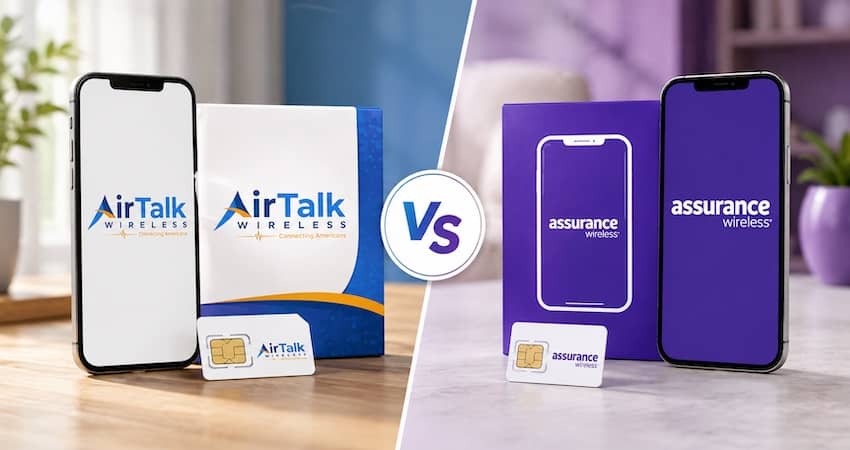
AirTalk Wireless and Assurance Wireless are both real, government-approved Lifeline carriers that give eligible households a free phone and free monthly service. Here’s the short version: AirTalk usually wins if you want more choice in phones and more data, while Assurance is the simpler, long-established pick with a free Android phone and a solid track record. Both run mainly on the T-Mobile network, so coverage where you live will be very similar.
Below we compare them head-to-head on network, phones, data, extras, cost, availability, and customer service, so you can pick the one that fits your life. Both are part of the federal Lifeline program, which gives eligible people free or discounted phone service.
The short answer: AirTalk vs Assurance at a glance
- Pick AirTalk Wireless if you want a wider phone selection (it advertises Apple and Samsung models), more monthly data, or free international calling. Just know its customer service gets mixed reviews.
- Pick Assurance Wireless if you want a simple, reliable free Android phone from a carrier that’s owned by T-Mobile and has been around since 2008.
- Either way, check coverage at your ZIP code first. Since both use T-Mobile, the winner often comes down to phones, data, and service rather than signal.
You can read our full AirTalk Wireless review and Assurance Wireless review for the deep dives. This guide puts them side by side.
AirTalk vs Assurance Wireless comparison table
| Feature | AirTalk Wireless | Assurance Wireless |
|---|---|---|
| Network | T-Mobile | T-Mobile |
| Monthly cost with Lifeline | $0 | $0 |
| Free phone | Free Android; Apple & Samsung models in some states (premium phones may need a co-pay) | Free Android smartphone (entry to mid-level) |
| Monthly high-speed data | Varies by state, up to about 15GB (some plans higher) | Varies by state, often around 10GB; up to 15GB with a low-cost add-on |
| Talk & text | Unlimited | Unlimited |
| International calling | Free to 200+ countries | Limited |
| Bring your own phone | Yes (eSIM supported) | Yes (unlocked phone + new SIM) |
| Keep your number | Yes | Yes |
| States served | 30+ and growing | 40+ |
| Owned by | HTH Communications | T-Mobile USA |
| Best for | More phone choice, more data, international calls | A simple, reliable free Android phone |
Offers, phones, and data amounts change often and vary by state. Always check the current offer for your ZIP code before you apply.
Network and coverage: a near tie
Here’s something most comparisons miss: AirTalk and Assurance both run primarily on the T-Mobile network. Assurance is actually owned by T-Mobile, and AirTalk is a virtual carrier that rides the same towers.
What does that mean for you? Your call quality, data speed, and signal will be about the same on either one. So if T-Mobile works well in your area, both are good options. If T-Mobile is weak where you live, neither will fix that, and you may want a Verizon-based carrier instead (more on that below).
One small note: on Lifeline plans, both carriers put you on a lower-priority data tier. In busy areas at peak times, your data may slow down a little compared to full-price customers. This is normal for free government phone plans.
Free phones and devices: AirTalk offers more choice
This is the biggest real difference between the two.
AirTalk Wireless is one of the few Lifeline carriers that advertises Apple and Samsung phones, not just basic Android handsets. That’s a genuine draw. But read the fine print before you get your hopes up:
- The phone that’s truly free is usually a basic smartphone.
- Nicer models (like an iPhone) depend on your state, current stock, and often a one-time co-pay.
- Which models are offered changes all the time.
So treat any “free iPhone” ad with healthy caution. Our guide on whether you can get a free government iPhone explains what’s realistic and what’s marketing.
Assurance Wireless keeps it simple: you get a free Android smartphone. The exact model varies and is usually an entry-level or mid-level device. There’s no iPhone option. If all you need is a working phone for calls, texts, appointments, and emergencies, that’s perfectly fine.
Want to see what’s out there across all carriers? Browse our roundup of the best Lifeline phones.
Plans and data: how much you get each month
Both carriers give you unlimited talk and text and a monthly pool of high-speed data. Both plans cost $0 per month because the federal Lifeline discount of $9.25 a month covers the basic plan. If you live on qualifying Tribal lands, that discount rises to $34.25 a month, which usually means even more data.
- AirTalk data: Varies by state, commonly up to about 15GB, with some plans offering more. AirTalk tends to market larger data amounts.
- Assurance data: Varies by state, often around 10GB. You can add more (up to 15GB) through a low-cost “Data Peace of Mind” upgrade for about $10 a year. California and Tribal residents often get enhanced offers.
Because these amounts change and differ by state, don’t treat any single number as final. Check the current plan for your area when you apply. For more on the discount and who qualifies, see our pages on the Lifeline discount amount and Lifeline eligibility.
Extra features: international calling, hotspot, and BYOP
A few smaller perks can tip the scale:
- International calling. AirTalk includes free calling to 200+ countries, which is a real advantage if you have family abroad. Assurance’s international calling is more limited.
- Bring your own phone. Both let you keep a phone you already like. AirTalk supports eSIM, so newer phones can activate without a physical SIM. Assurance needs an unlocked, compatible phone plus a new SIM card. Our bring your own phone guide walks through how it works.
- Hotspot. Both may offer hotspot (tethering) depending on your phone and plan. Availability varies, so confirm it before you rely on it.
Availability: which states each one covers
Assurance Wireless is one of the largest Lifeline providers in the country and is available in 40+ states. AirTalk Wireless is available in 30+ states and is expanding quickly.
Coverage lists change as carriers add or drop service areas, so the only way to know for sure is to check your own ZIP code. Use the official “Companies Near Me” tool at lifelinesupport.org/companies-near-me to confirm a carrier serves your address before you apply. Our guide on how to verify a Lifeline provider shows you how.
Customer service and reputation: the honest picture
No free phone carrier is perfect, and both of these get their share of complaints. Here’s a fair look at each.
AirTalk Wireless earns praise for a fast, easy application, quick approvals, and generous data and phone options. On the downside, reviews across sites are mixed to negative. The most common complaints are about hard-to-reach customer support, long hold times, and hassles getting a defective phone replaced. If you sign up, keep records of your order and any support tickets. You can track your application through our guide on checking your AirTalk application status.
Assurance Wireless generally gets credit for a straightforward application and reliable T-Mobile coverage. Its most common complaints are about occasional activation snags (often fixed on a second try), slower shipping, and stricter international calling. Because Assurance is owned by T-Mobile and has run since 2008, it’s a well-known, stable option. If you ever need help, see our pages on Assurance phone replacement and checking your Assurance application status.
Bottom line: AirTalk offers more, but you may have to be patient with support. Assurance offers less variety, but it’s simple and predictable.
Which one should you choose?
Choose AirTalk Wireless if:
- You want more choice in phones, including Apple or Samsung models.
- You want the most data you can get each month.
- You call family or friends in other countries.
- You’re comfortable troubleshooting on your own if support is slow.
Choose Assurance Wireless if:
- You just want a simple, reliable free Android phone.
- You prefer a big, established carrier owned by T-Mobile.
- You don’t need a premium phone or heavy international calling.
- You value a smooth, predictable setup over extra perks.
Still not sure? Check coverage first
Since both carriers use T-Mobile, start by checking whether T-Mobile has strong signal at your home and the places you spend time. If it does, either one will serve you well, so let phones, data, and service decide.
If T-Mobile is weak in your area, consider a Verizon-based Lifeline carrier instead. Our SafeLink vs Assurance comparison covers a strong Verizon-network option. You can also browse all your choices on our best Lifeline providers page.
How to apply (or switch)
Applying is free and takes just a few minutes:
- Confirm you qualify. You can qualify through programs like SNAP, Medicaid, SSI, Federal Public Housing, Veterans Pension, or by income (at or below 135% of the Federal Poverty Guidelines). See our eligibility guide.
- Check your ZIP. Make sure the carrier serves your address on lifelinesupport.org.
- Apply. Follow the steps in our how to apply for Lifeline guide, or apply directly on the carrier’s site.
Already have one of these carriers and want to move to the other? Lifeline lets you switch providers (usage rules apply). Learn how in our how to switch Lifeline providers guide, and see how to keep your phone number when you move.
Frequently asked questions
It depends on what you need. AirTalk is better for phone choice, more data, and international calling. Assurance is better for a simple, reliable free Android phone from a large, T-Mobile-owned carrier. Both are legitimate, free, and run on the same network.
Yes. Both run primarily on the T-Mobile network. That means coverage and speeds are very similar on either carrier, so your choice usually comes down to phones, data, and customer service.
AirTalk advertises Apple phones in some states, but the truly free device is usually a basic smartphone, and iPhones often depend on your state, stock, and a possible co-pay. Assurance is Android-only and does not offer iPhones. Be cautious with any “free iPhone” ad and check what’s actually available for your ZIP.
No. Lifeline is one benefit per household, not per person. You can only have one Lifeline phone or discount at a time. If you want to move from one carrier to the other, you switch rather than sign up twice.
Yes. Both are part of the federal Lifeline program, which provides a $9.25 monthly discount (up to $34.25 on Tribal lands). That covers the basic plan, so your bill is $0. No honest Lifeline provider charges an application fee. If anyone asks you to pay to “sign up,” treat it as a warning sign.